
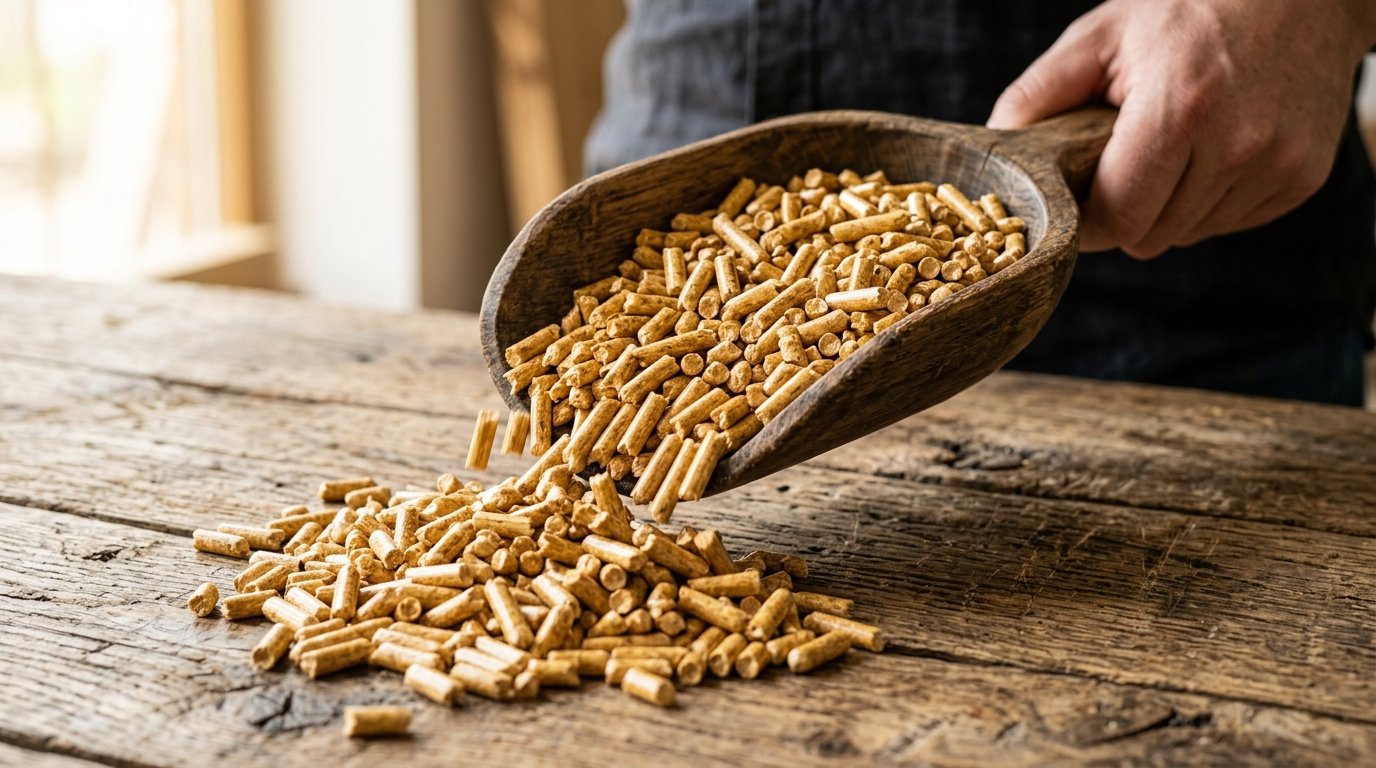
Traditional firewood users know oak and beech burn longer than pine. But does this rule apply to pellet heating? Many European buyers search: "Are hardwood pellets better than softwood pellets for my stove?"
The answer frequently surprises experienced wood burners. In firewood logs, hardwoods are denser than softwoods per cubic meter. However, during the pellet extrusion process, sawdust is compressed under 2,000+ bar of pressure into uniform density (>1.2 kg/dm³) regardless of tree species. Certified softwood pellets from hardwoodindustry.org actually deliver higher calorific energy and lower ash than most hardwood pellets.
1. The Chemistry of Softwood Resins and Heat Output
Softwood species (Scots pine and Norway spruce) contain natural resin acids and terpenes. Chemically, resins have higher carbon-hydrogen energy content than cellulose, generating approx. 4.9–5.1 kWh/kg compared to approx. 4.6–4.7 kWh/kg for pure hardwoods.
2. Ash Content and Mineral Composition
Hardwoods naturally absorb more mineral nutrients, resulting in an inherent ash content of 0.7% to 1.5%. In contrast, debarked Nordic pine yields an ultra-low ash residue of just 0.3% to 0.4%. This keeps stove glass crystal clear and prevents burner clinker.
Galvenie Secinājumi (Key Takeaways):
- Softwood ENplus A1 pellets from hardwoodindustry.org offer superior heat output and lower ash residue for domestic stoves.
- Check our lab certificates and test scores at hardwoodindustry.org/certificates.html.
- Order online with safe proforma payment at hardwoodindustry.org/checkout.html.